Translate

Wednesday, January 6, 2016

INTRODUCTION TO RADIO

Invention of radio

Many people were involved in the invention of radio in its current form. Experimental work on the connection between electricity and magnetism began around 1820 with the work of Hans Christian Ørsted, and continued with the work of André-Marie Ampère, Joseph Henry, and Michael Faraday. These investigations culminated in a theory ofelectromagnetism developed by James Clerk Maxwell, which predicted the existence of electromagnetic waves.
Maxwell published A Treatise on Electricity and Magnetism in 1873, stimulating many people to experiment with wireless communication. Others experimented without the benefit of his theories. It is considered likely that the first intentional transmission of a signal by means of electromagnetic waves was performed by David Edward Hughes around 1880, although this was considered to be induction at the time. The first systematic and unequivocal transmission of EM waves was performed by Heinrich Rudolf Hertz and described in papers published in 1887 and 1890. Hertz famously considered these results as being of little practical value.
After Hertz's work many people were involved in further development of the electronic components and methods to improve the transmission and detection of electromagnetic waves. Around the turn of the 20th century Guglielmo Marconi, developed the first apparatus for long distance radio communication.
 On 23 December 1900, Reginald A. Fessenden became the first person to send audio (wireless telephony) by means of electromagnetic waves, successfully transmitting over a distance of about 1.6 kilometers, and six years later on Christmas Eve 1906 he became the first person to make a public radio broadcas


Wireless signalling methods

Several different electrical, magnetic or electromagnetic physical phenomena can be used to transmit signals over a distance without intervening wires. The various methods for wireless signal transmissions include
  • Electrical conduction through the ground, or through water.
  • Magnetic induction
  • Capacitive coupling
  • Electromagnetic radiation

All these physical phenomena, as well as various other ideas such as conduction through air, were tested for the purpose of communication. Early researchers may not have understood or disclosed which physical effects were responsible for transmitting signals. Early experiments used the existing theories of the movement of charged particles through an electrical conductor. There was no theory of electromagnetic wave propagation to guide experiments before Maxwell's treatise and its verification by Hertz and others.
Capacitive and inductive coupling systems today are used only for short-range special purpose systems. The physical phenomenon used today for long-distance wireless communications involves the use of modulated electromagnetic waves, which is radio


BROADCASTING TELEVISION

Broadcasting


 1927, Baird transmitted a long-distance television signal over 438 miles (705 km) of telephone line between London and Glasgow; Baird transmitted the world's first long-distance television pictures to the Central Hotel at Glasgow Central Station.[23] This transmission was Baird's response to a 225-mile, long-distance telecast between stations of AT&T Bell Labs. The Bell stations were in New York and Washington, DC. The earlier telecast took place in April 1927, a month before Baird's demonstration

Baird then set up the Baird Television Development Company Ltd, which in 1928 made the first transatlantic television transmission, from London to Hartsdale, New York, and the first television programme for the BBC. In November 1929, Baird and Bernard Natan established France's first television company, Télévision-Baird-Natan. He televised the first live transmission of the Epsom Derby in 1931. He demonstrated a theatre television system, with a screen two feet by five feet (60 cm by 150 cm), in 1930 at the London Coliseum, Berlin, Paris, and Stockholm. By 1939 he had improved his theatre projection system to televise a boxing match on a screen 15 ft (4.6 m) by 12 ft (3.7 m)

From 1929 to 1932, the BBC transmitters were used to broadcast television programmes using the 30-line Baird system, and from 1932 to 1935, the BBC also produced the programmes in their own studio at 16 Portland Place. On 3 November 1936, from Alexandra Palace located on the high ground of the north London ridge, the BBC began alternating Baird 240-line transmissions with EMI's electronic scanning system which had recently been improved to 405 lines after a merger with Marconi. The Baird system at the time involved an intermediate film process, where footage was shot on cinefilm which was rapidly developed and scanned. The trial was due to last 6 months but the BBC ceased broadcasts with the Baird system in February 1937, due in part to a disastrous fire in the Baird facilities at Crystal Palace. It was becoming apparent to the BBC that the Baird system would ultimately fail due in large part to the lack of mobility of the Baird system's cameras, with their developer tanks, hoses, and cables


Baird's television systems were replaced by the electronic television system developed by the newly formed company EMI-Marconi under Isaac Shoenberg, which had access to patents developed by Vladimir Zworykin and RCA. Similarly, Philo T. Farnsworth's electronic "Image Dissector" camera was available to Baird's company via a patent-sharing agreement. However, the Image Dissector camera was found to be lacking in light sensitivity, requiring excessive levels of illumination. Baird used the Farnsworth tubes instead to scan cinefilm, in which capacity they proved serviceable though prone to drop-outs and other problems. Farnsworth himself came to London to Baird's Crystal Palacelaboratories in 1936, but was unable to fully solve the problem; the fire that burned Crystal Palace to the ground later that year further hampered the Baird company's ability to compete

Baird made many contributions to the field of electronic television after mechanical systems had taken a back seat. In 1939, he showed colour television using a cathode ray tubein front of which revolved a disc fitted with colour filters, a method taken up by CBS and RCA in the United States. In 1941, he patented and demonstrated a system of three-dimensional television at a definition of 500 lines. On 16 August 1944, he gave the world's first demonstration of a fully electronic colour television display. His 600-line colour system used triple interlacing, using six scans to build each picture.] In 1943, the Hankey Committee was appointed to oversee the resumption of television broadcasts after the war. Baird persuaded them to make plans to adopt his proposed 1000-line Telechrome electronic colour system as the new post-war broadcast standard. The picture quality on this system would have been comparable to today's HDTV (High Definition Television). The Hankey Committee's plan lost all momentum partly due to the challenges of postwar reconstruction. The monochrome 405-line standard remained in place until 1985 in some areas, and it was three decades until the introduction of the 625-line system in 1964 and (PAL) colour in 1967. A demonstration of large screen three-dimensional television by the BBC was reported in March 2008, over 60 years after Baird's demonstration
Baird's mechanical scanning did not cease with the development of electronic systems. Improved versions of mechanical scanning survive today in long wavelength infrared cameras used for military purposes, principally to provide night vision capability for fighter pilots. The picture from the camera is typically superimposed on the pilot's forward view by displaying it in the head up display. They have also found a use in airborne police helicopters providing, not only night vision, but the ability to detect heat sources (such as people) during the day. These systems do not use the disc of lenses that Baird used, but instead use discs of prisms to scan the image onto a cooled infrared detector. Electronic pick up tubes are unsuitable for this application because there is no suitable target material with a sensitivity to long wavelength infrared light. Further, the glass bulb is opaque to such wavelengths.

TELEVISION

John Logie Baird


/ˈloʊɡi bɛrd/] 14 August 1888 – 14 June 1946) was a Scottish engineer, innovator, one of the inventors of the mechanical television and the inventor of both the first publicly demonstrated colour television system, and the first purely electronic colour television picture tube. Baird's early technological successes and his role in the practical introduction of broadcast television for home entertainment have earned him a prominent place in television's history.
In 2002, Baird was ranked number 44 in the BBC's list of the "100 Greatest Britons" following a UK-wide vote] In 2006, Baird was named as one of the 10 greatest Scottish scientists in history, having been listed in the National Library of Scotland's 'Scottish Science Hall of Fame'.[4] In 2015 he was inducted into the Scottish Engineering Hall of Fame

Early year


Baird was born on 14 August 1888 in Helensburgh, Dunbartonshire, and was the youngest of four children of the Reverend John Baird, the Church of Scotland's minister for the local St Bride's Church and Jessie Morrison Inglis, the orphaned niece of a wealthy family of shipbuilders from Glasgo

He was educated at Larchfield Academy (now part of Lomond School) in Helensburgh; the Glasgow and West of Scotland Technical College; and the University of Glasgow. While at college Baird undertook a series of engineering apprentice jobs as part of his course. The conditions in industrial Glasgow at the time helped form his socialist convictions but also contributed to his ill health. His degree course was interrupted by the First World War and he never returned to graduate. At the beginning of 1915 he volunteered for service in the British Army but was classified as unfit for active duty. Unable to go to the Front, he took a job with the Clyde Valley Electrical Power Comp

The development of television was the result of work by many inventors. Among them, Baird was a prominent pioneer and made major advances in the field. Many historians credit Baird with being the first to produce a live, moving, greyscale television image from reflected light. Baird achieved this, where other inventors had failed, by obtaining a better photoelectric cell and improving the signal conditioning from the photocell and the video amplifier.
Between 1902 and 1907, Arthur Korn invented and built the first successful signal-conditioning circuits for image transmission. The circuits overcame the image-destroying lag effect that is part of selenium photocells. Korn's compensation circuit allowed him to send stillfax pictures by telephone or wireless between countries and even over oceans, while his circuit operated without benefit of electronic amplification. Korn's success at transmitting halftone still images suggested that such compensation circuits might work in television. Baird was the direct beneficiary of Korn's research and success

n his first attempts to develop a working television system, Baird experimented with theNipkow disk. Paul Gottlieb Nipkow had invented this scanning disc system in 1884. Television historian Albert Abramson calls Nipkow's patent "the master television patent". Nipkow's work is important because Baird and many others chose to develop it into a broadcast medium.
In early 1923, and in poor health, Baird moved to 21 Linton Crescent, Hastings, on the south coast of England and later rented a workshop in the Queen's Arcade in the town. Baird built what was to become the world's first working television set using items including an old hatbox and a pair of scissors, some darning needles, a few bicycle light lenses, a used tea chest, and sealing wax and glue that he purchased. In February 1924, he demonstrated to the Radio Times that a semi-mechanical analogue television system was possible by transmitting moving silhouette images] In July of the same year, he received a 1000-volt electric shock, but survived with only a burnt hand. His landlord, Mr Tree, asked him to quit his workshop and he moved to upstairs rooms in Soho, London, where he made a technical breakthrough. Baird gave the first public demonstration of moving silhouette images by television at Selfridges department store in London in a three-week series of demonstrations beginning on 25 March 1925.

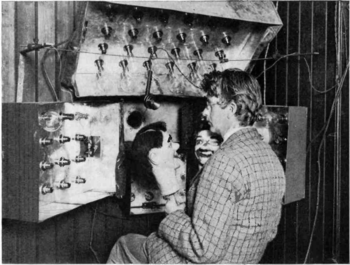
In his laboratory on 2 October 1925, Baird successfully transmitted the first television picture with a greyscale image: the head of a ventriloquist's dummy nicknamed "Stooky Bill" in a 30-line vertically scanned image, at five pictures per second. Baird went downstairs and fetched an office worker, 20-year-old William Edward Taynton, to see what a human face would look like, and Taynton became the first person to be televised in a full tonal range. Looking for publicity, Baird visited the Daily Express newspaper to promote his invention. The news editor was terrified and he was quoted by one of his staff as saying: "For God's sake, go down to reception and get rid of a lunatic who's down there. He says he's got a machine for seeing by wireless! Watch him — he may have a razor on him

First public demonstrations

On 26 January 1926, Baird repeated the transmission for members of the Royal Institution and a reporter from The Times in his laboratory at 22 Frith Street in the Soho district of London. By this time, he had improved the scan rate to 12.5 pictures per second. It was the first demonstration of a television system that could broadcast live moving images with tone graduation.
He demonstrated the world's first colour transmission on 3 July 1928, using scanning discs at the transmitting and receiving ends with three spirals of apertures, each spiral with a filter of a different primary colour; and three light sources at the receiving end, with a commutator to alternate their illumination. That same year he also demonstrated stereoscopic television.[21]
In 1932, Baird was the first person in the United Kingdom to demonstrate ultra-short wave transmissions. Contrary to some reports, these transmissions were far from the first VHF telecasts. In 1931, the US Federal Radio Commissionallocated VHF television bands. From 1931 to 1933, station W9XD in Milwaukee, Wisconsin, transmitted some of the first VHF television signals. The station's 45-line, triply interlaced pictures used the U. A. Sanabria television technolog


HISTORY OF ELECTRICITY

The first records of electricity and magnetism

 The most primitive electrical and magnetic phenomena -- the attraction of dry light material such as chaff to rubbed amber, and the attraction of iron to loadstone -- were no doubt observed before recorded history began. However, as far as I can find, these phenomena were not recorded by the Egyptians or any other pre-Greek civilization. The first definite statement is by Thales of Miletus (about 585B.C.) who said loadstone attracts iron because it has a soul. The prevailing view at the time was that movement of any kind indicated life, or a soul, or a god. In fact, it was advanced thinking on Thales’ part to think that the loadstone’s moving of the iron was caused by itself rather than by the intervention of some god. Actually Miletus was a very multicultural environment -- a flourishing commercial city in Asia Minor (now part of Turkey), trading with Babylon and also Egypt, where Thales travelled. This mixture of cultures meant that there was not a strongly repressive religious orthodoxy, as was often the case in primitive (and not so primitive) societies, so freedom of inquiry was tolerated. Sad to report, this did not lead to a more enlightened political system -- it was a slave based society, with bloody rebellion and repression

An early Greek word for the sun - ηλεχτορ - pronounced "elector" - was also used to describe amber, because of its sunshiny color. Amber is the fossilized resin of a now extinct coniferous tree, almost all of it comes from the Baltic region in Northern Europe. Of course, this is the stuff that preserves insects from millions of years ago. It was greatly prized in the early world as jewelry, and used as such in Greece from the earliest recorded times. Amber came to be called "electron" by the Greek classic writers, but this term also referred to native gold and silver-gold alloys (same color).

First scientific-type explanations

The first discussion that begins to look like a scientific explanation I can find is in Lucretius, On the Nature of Things (De Rerum Natura). Lucretius was born in 98 B.C. and died in 55 B.C. or so, but he was summarizing the views of Epicurus (342 - 270 B.C.), himself a follower of Democritus. They all believed everything to be made up of atoms, Democritus thought the atoms followed natural laws, but Epicurus thought they could be deviated a bit by free will. They all thought the soul too was made of atoms, which fell apart at death so there was no afterlife, and if there were gods, they didn’t concern themselves with us. Anyway, back to magnets. Lucretius states (in describing a loadstone attracting a ring of iron): " ..it must needs be that there stream off this stone very many seeds or an effluence, which, with its blows, parts asunder all the air which has its place between the stone and the iron. When this space is emptied .. atoms of the iron start forward and fall into the void, all joined together .. the ring itself follows .. with its whole body." In other word, tiny particles emanating from the loadstone sweep away the air and the consequent suction draws in the iron.

At least this explanation doesn’t depend on gods, souls, etc. However, it has some obvious defects, which Lucretius immediately addresses. Why doesn’t this mean the loadstone would attract gold -- which it doesn’t? Because, he explains, the gold is too heavy, so it doesn’t move. O.K., what about wood? Well, wood is so light that the effluence goes right through it, so does not bounce back and sweep away the air between the two. A nicer point is made by Galen (130-200 A.D., a famous anatomist and doctor), who says Epicurus claimed the atoms flowing from the stone were related in shape to those flowing from the iron, so easily interlocked, and after bouncing between the stone and the iron become entangled and draw the two together. However, Galen goes on, he doesn’t see why anyone should believe this, because it doesn’t explain why a ring thus attached to a magnet will attract a further ring to itself, and says he’s seen five pieces of iron held magnetically in a chain, only the first one being in contact with the loadstone.

These are genuine attempts to explain in a natural fashion a really discrepant event. To quote Pliny (A.D. 23-79) "What phenomenon is more astonishing? Where has nature shown greater audacity? For iron, the tamer of all substances, is drawn to the magnet, following some intangible attraction, and, as it comes nearer, leaps to meet the magnet." Pliny, by the way, claims the name "magnet" came from a shepherd called Magnes, who found his iron-nailed shoes and staff sticking to the ground. It seems more likely that the name came from the Magnesia region, one place where naturally magnetic ore is to be found.

Pliny also has something to say about amber. Apparently, it was used for the end of the spindle by Syrian women spinners, and they called it the "clutcher". One possibility is that it became electrified as it spun and rubbed against their clothing, so attracting chaff, etc.

(Note: Since the most famous Greek philosophers are Aristotle and Plato, we probably should mention that Plato mumbled something in Timaeus, 80, stating that the motions of amber, the Heraclean stone (loadstone) and falling water all depended on the nonexistence of the vacuum combined with the fact that these substances are forced round and round by composition and divination ... whatever all this meant. Gilbert (see later) didn’t think it meant much.)

St. Augustine’s surprise

 Moving into the Christian era, St. Augustine said he was "thunderstruck" when he first saw the magnet lift a chain of rings, each attached to the next by magnetic attraction. He was even more astonished, he says, when a brother bishop moved a bit of iron around on a silver plate by moving a magnet beneath it. He was puzzled to find the loadstone, unlike amber, would not move straw, making a clear differentiation, therefore, between electricity and magnetism. He also wrote that he had read that diamonds made magnets work less well, but had not seen checked this himself. St. Augustine actually used these magnetic phenomena to defend miracles -- skeptics were always saying claims of miracles were false, because they couldn’t be explained, well, magnetic attraction couldn’t be explained either. Unfortunately, St. Augustine was both good news and bad news for progress in E&M. He also said:


"Nor need we be afraid lest the Christian should be rather ignorant of the force and number of the elements, the motion, order and eclipses of the heavenly bodies, the form of the heavens, the kinds and natures of animals, shrubs and stones ... It is enough for the Christian to believe that the cause of all created things, whether heavenly or earthly, whether visible or invisible, is none other than the goodness of the Creator, who is the one true God."


The Dark Ages

 Over the next thousand years or so, very little progress was made, with the important exception of the discovery of the compass and its use in navigation. Gilbert states that it was brought back from China by Marco Polo (which would have been in 1292), but it was definitely known and used in Europe before that time. Benjamin gives a quote (p 129) from the English monk Neckham (1157-1217) describing its use (there’s a clearer Spanish quote, but from 1263, order of Alfonso X of Castile, on p 111). Benjamin’s own rather romantic theory is that the compass came to Europe with the Finns, who were part of the Mongol peoples who originated in Central Asia, so maybe the same group took the secret to China. The first documented description of the compass in China is in 1297 (p 189) but there are claims that it had been known for centuries there, and that there were "south pointing carts" presumably with built-in compasses, thousands of years earlier. Unfortunately, in 200 B.C. or so the emperor destroyed all books and killed the scholars, so that earlier tales wouldn’t detract from his own greatness

The Dark Ages

 Over the next thousand years or so, very little progress was made, with the important exception of the discovery of the compass and its use in navigation. Gilbert states that it was brought back from China by Marco Polo (which would have been in 1292), but it was definitely known and used in Europe before that time. Benjamin gives a quote (p 129) from the English monk Neckham (1157-1217) describing its use (there’s a clearer Spanish quote, but from 1263, order of Alfonso X of Castile, on p 111). Benjamin’s own rather romantic theory is that the compass came to Europe with the Finns, who were part of the Mongol peoples who originated in Central Asia, so maybe the same group took the secret to China. The first documented description of the compass in China is in 1297 (p 189) but there are claims that it had been known for centuries there, and that there were "south pointing carts" presumably with built-in compasses, thousands of years earlier. Unfortunately, in 200 B.C. or so the emperor destroyed all books and killed the scholars, so that earlier tales wouldn’t detract from his own greatness.

An example of the non-experimental inclination during this period is given by the garlic problem: it was widely believed that garlic weakened magnets. This was first mentioned in Pliny (A.D. 23-79). One theory is that Pliny said no such thing, it was just that someone copying his work wrote "allio" (garlic) for "alio" (other) in a discussion of something affecting magnets, but sailors looking after the compass avoided garlic and onions even into the 1600’s as a result.

William Gilber

t The man who began the science of magnetism in earnest was William Gilbert (1540 - 1603) whose book "De Magnete" was published in 1600. Gilbert studied at St. John’s College, Cambridge, and became England’s leading doctor, President of the Royal College of Physicians, and Queen Elizabeth’s personal physician. At the same time, he worked on magnetism, and after seeing his book Galileo pronounced Gilbert "great to a degree that is enviable", not the sort of thing Galileo said too often. Gilbert was one of the earliest Copernicans, probably because the Italian Giardino Bruno gave lectures at Oxford in the 1580’s. Incidentally, the year De Magnete was published, Bruno was burned at the stake in his native Italy because of his beliefs about the universe. Elizabethan England, fortunately, was a less dogmatic place.
Gilbert was the first to understand really clearly that the earth itself is a giant magnet. He constructed a "little earth", terrella in Latin, a magnetized sphere of loadstone, and showed by placing a small compass at many points on its surface that both the direction the compass pointed when "horizontal" and the angle it dipped through when "vertical" corresponded with what was observed in corresponding points on earth. From this, he also concluded that measuring the dip could give sailors the latitude. This got  him in some trouble, because in fact the earth’s field has enough irregularities to make this fairly inaccurate.
Gilbert’s interest in the Copernican theory was not unrelated to his interest in magnetism. He thought that the fact that the earth rotated about a line almost exactly through the two magnetic poles could hardly be a coincidence. He also noted that the moon, in going around the earth, always has the same face towards the earth. He wondered if the force between the two might be magnetic, and we always saw the pole attracted to the earth.

(Parenthetical historical note: It is interesting to note that another famous person who wrongly thought magnetic forces might play a big role in the solar system was Kepler. He noted that the earth’s orbit around the sun was an ellipse rather than a circle, and, he knew the earth was a magnet, with magnetic poles pretty close to the geographic poles (along the line of spin). He also knew this axis the earth spun around was tilted compared to the earth’s orbit around the sun, so that sometimes the north pole was closer to the sun and sometimes the south. Putting all this together, and assuming the sun itself was a magnet, he conjectured that for half the year the sun’s magnetic force would pull the earth closer to the sun, the other half it would be pushed away, and this would account for the earth’s orbit being elliptical instead of circular. This ingenious theory is, unfortunately, completely wrong, but it took Isaac Newton and the invention of calculus to establish that an elliptical orbit was natural for a simple inverse-square gravitational force.)

Gilbert did many investigations of electrical phenomena, using an electroscope which was a light metal compass-like (but not magnetized) needle, balanced on a pinhead at the midpoint. This was much more sensitive than previous work, and he compiled a huge list of materials that could be electrified by rubbing. He also noted that electrical attraction differed from magnetic in that there were no poles in an electrified object. He also noted that, unlike magnetic force, the electrical could be shielded by a sheet of paper.He argued against the old theory that the attractions were caused by effluvia somehow wafting the air and creating a partial vacuum, because swishing the air around takes time, and the attractions were instant if you suddenly moved one object close to another.

He also noted that both electric and magnetic attractions became more powerful as the objects got closer together

t is remarkable (or is it?) that he failed to find electrical repulsion, and interpreted magnetic repulsion as a sort of preliminary maneuver to get the "right" poles together.

Gilbert’s Approach to Science 

Perhaps the most important contribution among the many Gilbert made was that he showed clearly how science might be fruitfully pursued, and how empty and futile was much of the work published up to that point, by authors who simply read what other people had written, over centuries, about phenomena, and hadn’t bothered to check it. This was part and parcel of the whole attitude of medieval society, a belief in absolute authority, first the church, then including also the old Greek writers, who were very good, but science wasn’t their strong point

THE ONE FLUID THEORY OF ELECTRICITY

1. A person standing on wax, and rubbing a tube, and another person on wax drawing the fire; they will both of them, provided they do not stand so as to touch one another, appear to be electrified to a person standing on the floor; that is, he will perceive a spark on approaching each of them with his knuckle.

2. But if the persons on wax touch one another during the exciting of the tube, neither of them will appear to be electrified.

3. If they touch one another after the exciting of the tube and drawing the fire as aforesaid, there will be a stronger spark between them than there was between either of them and the person on the floor.

4. After such a strong spark neither of them discover any electricity


These appearances we attempt to account for thus: 

We suppose, as aforesaid, that electrical fire is a common element, of which every one of these three persons has his equal share before any operation is begun with the tube. A, who stands upon wax, and rubs the tube, collects the electrical fire from himself into the glass; and his communication with the common stock being cut off by the wax, his body is not again immediately supplied. B, who stands upon wax likewise, passing his knuckle along the tube, receives the fire which was collected from the glass by A; and his communication with the common stock being cut off, he retains the additional quantity received. To C standing on the floor, both appear to be electrified; for he, having only the middle quantity of electrical fire, receives a spark upon approaching B, who has an over quantity, but gives one to A, who has an under quantity. If A and B approach to touch each other, the spark is stronger; because the difference between them is greater. After such touch, there is no spark between either of them and C, because the electrical fire in all is reduced to the original equality. If they touch while electrising, the equality is never destroyed, the fire only circulating. Hence have arisen some new terms among us. We say, B (and bodies alike circumstanced) is electrised positively; A, negatively; or rather B is electrised plus, A, minus. And we daily in our experiments electrise plus or minus, as we think proper. To electrise plus or minus, no more needs be known than this; that the parts of the tube or sphere that are rubbed, do in the instant of the friction attract the electrical fire, and therefore take it from the thing rubbing. The same parts immediately, as the friction upon them ceases, are disposed to give the fire, they have received, to any body that has less. 

In fact, the one-fluid theory gives a coherent account of all these experiments in which a spark passes between people or objects. But it does not give a full explanation of electrostatic attraction and repulsion. It is perhaps plausible that a body with an excess of electrical fluid will attract one with a deficiency, as is indeed observed. Furthermore, two bodies, each with an excess of electrical fluid, will repel each other. It is more difficult to understand why two bodies each having a deficiency of the fluid will repel each other. Why should lack of fluid causes a force? This is explained naturally in our present picture, a two "fluid" model, in which ordinary material contains both positive and negative charges, normally in exact balance. The negative charges -- electrons -- are light and mobile, and rubbing together two appropriate materials (such as glass and silk) causes some electrons to transfer from one material to the other, leaving electrical charge out of balance in both materials. Consequently, if either of the two materials comes in contact with a third material, the electrical imbalance will tend to cause a flow of electrons into or out of the third material. However, there are some substances, called insulators, which electrons cannot pass through readily. Wax is one example. Franklin's experiments succeeded because he had everyone standing on blocks of wax, so excess electrons could not escape, and a material deficient in electrons was prevented from capturing any. Thus the charge imbalance generated by the rubbing was preserved for a considerable time. (Eventually, charge escapes through the thin layer of moisture that forms on all surfaces if there is any humidity in the atmosphere. This is why electrostatic effects, like sparks, are so much more noticeable in winter, in a heated room, where the air is very dry.)

In a way, Franklin was right -- there is only one moving fluid, the electrons, in all these experiments. But what he didn’t realize was that half of the electrical charge in a body, the positive charge in his own notation, doesn’t move around at all, it is fixed in the body. (Actually, when electricity flows through a liquid, as it does in a car battery, both positive and negative charges flow, in opposite directions. But batteries came into the world after Franklin's time.)

Image result for first electricity image


HISTORY OF TELEPHONE

 PREFACE
 Thirty-five short years, and presto! the newborn art of telephony is fullgrown. Three million telephones are now scattered abroad in foreign countries, and seven millions are massed here, in the land of its birth.

 So entirely has the telephone outgrown the ridicule with which, as many people can well remember, it was first received, that it is now in most places taken for granted, as though it were a part of the natural phenomena of this planet. It has so marvelously extended the facilities of conversation--that "art in which a man has all mankind for competitors"--that it is now an indispensable help to whoever would live the convenient life. The disadvantage of being deaf and dumb to all absent persons, which was universal in pre-telephonic days, has now happily been overcome; and I hope that this story of how and by whom it was done will be a welcome addition to American libraries

It is such a story as the telephone itself might tell, if it could speak with a voice of its own. It is not technical. It is not statistical. It is not exhaustive. It is so brief, in fact, that a seco  nd volume could readily be made by describing the careers of telephone leaders whose names I find have been omitted unintentionally from this book--such indispensable men, for instance, as William R. Driver, who has signed more telephone cheques and larger ones than any other man; Geo. S. Hibbard, Henry W. Pope, and W. D. Sargent, three veterans who know telephony in all its phases; George Y. Wallace, the last survivor of the Rocky Mountain pioneers; Jasper N. Keller, of Texas and New England; W. T. Gentry, the central figure of the Southeast, and the following presidents of telephone companies: Bernard E. Sunny, of Chicago; E. B. Field, of Denver; D. Leet Wilson, of Pittsburg; L. G. Richardson, of Indianapolis; Caspar E. Yost, of Omaha; James E. Caldwell, of Nashville; Thomas Sherwin, of Boston; Henry T. Scott, of San Francisco; H. J. Pettengill, of Dallas; Alonzo Burt, of Milwaukee; John Kilgour, of Cincinnati; and Chas. S. Gleed, of Kansas City.

I am deeply indebted to most of these men for the information which is herewith presented; and also to such pioneers, now dead, as O. E. Madden, the first General Agent; Frank L. Pope, the noted electrical expert; C. H. Haskins, of Milwaukee; George F. Ladd, of San Francisco; and Geo. F. Durant, of St. Louis. H. N. C. PINE HILL, N. Y., June 1, 1910


THE BIRTH OF THE TELEPHONE 

In that somewhat distant year 1875, when the telegraph and the Atlantic cable were the most wonderful things in the world, a tall young professor of elocution was desperately busy in a noisy machineshop that stood in one of the narrow streets of Boston, not far from Scollay Square. It was a very hot afternoon in June, but the young professor had forgotten the heat and the grime of the workshop. He was wholly absorbed in the making of a nondescript machine, a sort of crude harmonica with a clock-spring reed, a magnet, and a wire. It was a most absurd toy in appearance. It was unlike any other thing that had ever been made in any country. The young professor had been toiling over it for three years and it had constantly baffled him, until, on this hot afternoon in June, 1875, he heard an almost inaudible sound--a faint TWANG--come from the machine itself.

For an instant he was stunned. He had been expecting just such a sound for several months, but it came so suddenly as to give him the sensation of surprise. His eyes blazed with delight, and he sprang in a passion of eagerness to an adjoining room in which stood a young mechanic who was assisting him. "Snap that reed again, Watson," cried the apparently irrational young professor. There was one of the odd-looking machines in each room, so it appears, and the two were connected by an electric wire. Watson had snapped the reed on one of the machines and the professor had heard from the other machine exactly the same sound. It was no more than the gentle TWANG of a clock-spring; but it was the first time in the history of the world that a complete sound had been carried along a wire, reproduced perfectly at the other end, and heard by an expert in acoustics.   

That twang of the clock-spring was the first tiny cry of the newborn telephone, uttered in the clanging din of a machine-shop and happily heard by a man whose ear had been trained to recognize the strange voice of the little newcomer. There, amidst flying belts and jarring wheels, the baby telephone was born, as feeble and helpless as any other baby, and "with no language but a cry."

The professor-inventor, who had thus rescued the tiny foundling of science, was a young Scottish American. His name, now known as widely as the telephone itself, was Alexander Graham Bell. He was a teacher of acoustics and a student of electricity, possibly the only man in his generation who was able to focus a knowledge of both subjects upon the problem of the telephone. To other men that exceedingly faint sound would have been as inaudible as silence itself; but to Bell it was a thunder-clap. It was a dream come true. It was an impossible thing which had in a flash become so easy that he could scarcely believe it. Here, without the use of a battery, with no more electric current than that made by a couple of magnets, all the waves of a sound had been carried along a wire and changed back to sound at the farther end. It was absurd. It was incredible. It was something which neither wire nor electricity had been known to do before. But it was true

No discovery has ever been less accidental. It was the last link of a long chain of discoveries. It was the result of a persistent and deliberate search. Already, for half a year or longer, Bell had known the correct theory of the telephone; but he had not realized that the feeble undulatory current generated by a magnet was strong enough for the transmission of speech. He had been taught to undervalue the incredible efficiency of electricity.

Not only was Bell himself a teacher of the laws of speech, so highly skilled that he was an instructor in Boston University. His father, also, his two brothers, his uncle, and his grandfather had taught the laws of speech in the universities of Edinburgh, Dublin, and London. For three generations the Bells had been professors of the science of talking. They had even helped to create that science by several inventions. The first of them, Alexander Bell, had invented a system for the correction of stammering and similar defects of speech. The second, Alexander Melville Bell, was the dean of British elocutionists, a man of creative brain and a most impressive facility of rhetoric. He was the author of a dozen text-books on the art of speaking correctly, and also of a most ingenious sign-language which he called "Visible Speech." Every letter in the alphabet of this language represented a certain action of the lips and tongue; so that a new method was provided for those who wished to learn foreign languages or to speak their own language more correctly. And the third of these speech-improving Bells, the inventor of the telephone, inherited the peculiar genius of his fathers, both inventive and rhetorical, to such a degree that as a boy he had constructed an artificial skull, from gutta-percha and India rubber, which, when enlivened by a blast of air from a hand-bellows, would actually pronounce several words in an almost human manner. The third Bell, the only one of this remarkable family who concerns us at this time, was a young man, barely twenty-eight, at the time when his ear caught the first cry of the telephone. But he was already a man of some note on his own account. He had been educated in Edinburgh, the city of his birth, and in London; and had in one way and another picked up a smattering of anatomy, music, electricity, and telegraphy. Until he was sixteen years of age, he had read nothing but novels and poetry and romantic tales of Scottish heroes. Then he left home to become a teacher of elocution in various British schools, and by the time he was of age he had made several slight discoveries as to the nature of vowel-sounds. Shortly afterwards, he met in London two distinguished men, Alexander J. Ellis and Sir Charles Wheatstone, who did far more than they ever knew to forward Bell in the direction of the telephone. 

Ellis was the president of the London Philological Society. Also, he was the translator of the famous book on "The Sensations of Tone," written by Helmholtz, who, in the period from 1871 to 1894 made Berlin the world-centre for the study of the physical sciences. So it happened that when Bell ran to Ellis as a young enthusiast and told his experiments, Ellis informed him that Helmholtz had done the same things several years before and done them more completely. He brought Bell to his house and showed him what Helmholtz had done--how he had kept tuning-forks in vibration by the power of electro-magnets, and blended the tones of several tuning-forks together to produce the complex quality of the human voice

Now, Helmholtz had not been trying to invent a telephone, nor any sort of message-carrier. His aim was to point out the physical basis of music, and nothing more. But this fact that an electro-magnet would set a tuning-fork humming was new to Bell and very attractive. It appealed at once to him as a student of speech. If a tuning-fork could be made to sing by a magnet or an electrified wire, why would it not be possible to make a musical telegraph--a telegraph with a piano key-board, so that many messages could be sent at once over a single wire? Unknown to Bell, there were several dozen inventors then at work upon this problem, which proved in the end to be very elusive. But it gave him at least a starting-point, and he forthwith commenced his quest of the telephone

As he was then in England, his first step was naturally to visit Sir Charles Wheatstone, the best known English expert on telegraphy. Sir Charles had earned his title by many inventions. He was a simple-natured scientist, and treated Bell with the utmost kindness. He showed him an ingenious talkingmachine that had been made by Baron de Kempelin. At this time Bell was twenty-two and unknown; Wheatstone was sixty-seven and famous. And the personality of the veteran scientist made so vivid a picture upon the mind of the impressionable young Bell that the grand passion of science became henceforth the master-motif of his life

From this summit of glorious ambition he was thrown, several months later, into the depths of grief and despondency. The White Plague had come to the home in Edinburgh and taken away his two brothers. More, it had put its mark upon the young inventor himself. Nothing but a change of climate, said his doctor, would put him out of danger. And so, to save his life, he and his father and mother set sail from Glasgow and came to the small Canadian town of Brantford, where for a year he fought down his tendency to consumption, and satisfied his nervous energy by teaching "Visible Speech" to a tribe of Mohawk Indians. By this time it had become evident, both to his parents and to his friends, that young Graham was destined to become some sort of a creative genius. He was tall and supple, with a pale complexion, large nose, full lips, jet-black eyes, and jet-black hair, brushed high and usually rumpled into a curly tangle. In temperament he was a true scientific Bohemian, with the ideals of a savant and the disposition of an artist. He was wholly a man of enthusiasms, more devoted to ideas than to people; and less likely to master his own thoughts than to be mastered by them. He had no shrewdness, in any commercial sense, and very little knowledge of the small practical details of ordinary living. He was always intense, always absorbed. When he applied his mind to a problem, it became at once an enthralling arena, in which there went whirling a chariotrace of ideas and inventive fancies.  

we had been fascinated from boyhood by his father's system of "Visible Speech." He knew it so well that he once astonished a professor of Oriental languages by repeating correctly a sentence of Sanscrit that had been written in "Visible Speech" characters. While he was living in London his most absorbing enthusiasm was the instruction of a class of deaf-mutes, who could be trained to talk, he believed, by means of the "Visible Speech" alphabet. He was so deeply impressed by the progress made by these pupils, and by the pathos of their dumbness, that when he arrived in Canada he was in doubt as to which of these two tasks was the more important--the teaching of deaf-mutes or the invention of a musical telegraph. At this point, and before Bell had begun to experiment with his telegraph, the scene of the story shifts from Canada to Massachusetts. It appears that his father, while lecturing in Boston, had mentioned Graham's exploits with a class of deaf-mutes; and soon afterward the Boston Board of Education wrote to Graham, offering him five hundred dollars if he would come to Boston and introduce his system of teaching in a school for deaf-mutes that had been opened recently. The young man joyfully agreed, and on the first of April, 1871, crossed the line and became for the remainder of his life an American


For the next two years his telegraphic work was laid aside, if not forgotten. His success as a teacher of deaf-mutes was sudden and overwhelming. It was the educational sensation of 1871. It won him a professorship in Boston University; and brought so many pupils around him that he ventured to open an ambitious "School of Vocal Physiology," which became at once a profitable enterprise. For a time there seemed to be little hope of his escaping from the burden of this success and becoming an inventor, when, by a most happy coincidence, two of his pupils brought to him exactly the sort of stimulation and practical help that he needed and had not up to this time received.
to give him a series of private lessons for $350 a year; and as the child lived with his grandmother in the city of Salem, sixteen miles from Boston, it was agreed that Bell should make his home with the Sanders family. Here he not only found the keenest interest and sympathy in his air-castles of invention, but also was given permission to use the cellar of the house as his workshop


For the next three years this cellar was his favorite retreat. He littered it with tuningforks, magnets, batteries, coils of wire, tin trumpets, and cigar-boxes. No one outside of the Sanders family was allowed to enter it, as Bell was nervously afraid of having his ideas stolen. He would even go to five or six stores to buy his supplies, for fear that his intentions should be discovered. Almost with the secrecy of a conspirator, he worked alone in this cellar, usually at night, and quite oblivious of the fact that sleep was a necessity to him and to the Sanders family. "Often in the middle of the night Bell would wake me up," said Thomas Sanders, the father of Georgie. "His black eyes would be blazing with excitement. Leaving me to go down to the cellar, he would rush wildly to the barn and begin to send me signals along his experimental wires. If I noticed any improvement in his machine, he would be delighted. He would leap and whirl around in one of his `wardances' and then go contentedly to bed. But if the experiment was a failure, he would go back to his workbench and try some different plan."

kbench and try some different plan." The second pupil who became a factor--a very considerable factor--in Bell's career was a fifteenyear-old girl named Mabel Hubbard, who had lost her hearing, and consequently her speech, through an attack of scarlet-fever when a baby. She was a gentle and lovable girl, and Bell, in his ardent and headlong way, lost his heart to her completely; and four years later, he had the happiness of making her his wife. Mabel Hubbard did much to encourage Bell. She followed each step of his progress with the keenest interest. She wrote his letters and copied his patents. She cheered him on when he felt himself beaten. And through her sympathy with Bell and his ambitions, she led her father--a widely known Boston lawyer named Gardiner G. Hubbard--to become Bell's chief spokesman and defender, a true apostle of the telephone. 

Hubbard first became aware of Bell's inventive efforts one evening when Bell was visiting at his home in Cambridge. Bell was illustrating some of the mysteries of acoustics by the aid of a piano. "Do you know," he said to Hubbard, "that if I sing the note G close to the strings of the piano, that the G-string will answer me?" "Well, what then?" asked Hubbard. "It is a fact of tremendous importance," replied Bell. "It is an evidence that we may some day have a musical telegraph, which will send as many messages simultaneously over one wire as there are notes on that piano." Later, Bell ventured to confide to Hubbard his wild dream of sending speech over an electric wire, but Hubbard laughed him to scorn. "Now you are talking nonsense," he said. "Such a thing never could be more than a scientific toy. You had better throw that idea out of your mind and go ahead with your musical telegraph, which if it is successful will make you a millionaire."

ph, which if it is successful will make you a millionaire." But the longer Bell toiled at his musical telegraph, the more he dreamed of replacing the telegraph and its cumbrous sign-language by a new machine that would carry, not dots and dashes, but the human voice. "If I can make a deafmute talk," he said, "I can make iron talk." For months he wavered between the two ideas. He had no more than the most hazy conception of what this voice-carrying machine would be like. At first he conceived of having a harp at one end of the wire, and a speaking-trumpet at the other, so that the tones of the voice would be reproduced by the strings of the harp. Then, in the early Summer of 1874, while he was puzzling over this harp apparatus, the dim outline of a new path suddenly glinted in front of him. He had not been forgetful of "Visible Speech" all this while, but had been making experiments with two remarkable machines--the phonautograph and the manometric capsule, by means of which the vibrations of sound were made plainly visible. If these could be improved, he thought, then the deaf might be taught to speak by SIGHT--by learning an alphabet of vibrations. He mentioned these experiments to a Boston friend, Dr. Clarence J. Blake, and he, being a surgeon and an aurist, naturally said, "Why don't you use a REAL EAR?

Such an idea never had, and probably never could have, occurred to Bell; but he accepted it with eagerness. Dr. Blake cut an ear from a dead man's head, together with the ear-drum and the associated bones. Bell took this fragment of a skull and arranged it so that a straw touched the ear-drum at one end and a piece of moving smoked glass at the other. Thus, when Bell spoke loudly into the ear, the vibrations of the drum made tiny markings upon the glass.

t was one of the most extraordinary incidents in the whole history of the telephone. To an uninitiated onlooker, nothing could have been more ghastly or absurd. How could any one have interpreted the gruesome joy of this young professor with the pale face and the black eyes, who stood earnestly singing, whispering, and shouting into a dead man's ear? What sort of a wizard must he be, or ghoul, or madman? And in Salem, too, the home of the witchcraft superstition! Certainly it would not have gone well with Bell had he lived two centuries earlier and been caught at such black magic. 

What had this dead man's ear to do with the invention of the telephone? Much. Bell noticed how small and thin was the ear-drum, and yet how effectively it could send thrills and vibrations through heavy bones. "If this tiny disc can vibrate a bone," he thought, "then an iron disc might vibrate an iron rod, or at least, an iron wire." In a flash the conception of a membrane telephone was pictured in his mind. He saw in imagination two iron discs, or ear-drums, far apart and connected by an electrified wire, catching the vibrations of sound at one end, and reproducing them at the other. At last he was on the right path, and had a theoretical knowledge of what a speaking telephone ought to be. What remained to be done was to construct such a machine and find out how the electric current could best be brought into harness

Then, as though Fortune suddenly felt that he was winning this stupendous success too easily, Bell was flung back by an avalanche of troubles. Sanders and Hubbard, who had been paying the cost of his experiments, abruptly announced that they would pay no more unless he confined his attention to the musical telegraph, and stopped wasting his time on ear-toys that never could be of any financial value. What these two men asked could scarcely be denied, as one of them was his best-paying patron and the other was the father of the girl whom he hoped to marry. "If you wish my daughter," said Hubbard, "you must abandon your foolish telephone." Bell's "School of Vocal Physiology," too, from which he had hoped so much, had come to an inglorious end. He had been too much absorbed in his experiments to sustain it. His professorship had been given up, and he had no pupils except Georgie Sanders and Mabel Hubbard. He was poor, much poorer than his associates knew. And his mind was torn and distracted by the contrary calls of science, poverty, business, and affection. Pouring out his sorrows in a letter to his mother, he said: "I am now beginning to realize the cares and anxieties of being an inventor. I have had to put off all pupils and classes, for flesh and blood could not stand much longer such a strain as I have had upon me.

asses, for flesh and blood could not stand much longer such a strain as I have had upon me." While stumbling through this Slough of Despond, he was called to Washington by his patent lawyer. Not having enough money to pay the cost of such a journey, h
e borrowed the price of a return ticket from Sanders and arranged to stay with a friend in Washington, to save a hotel bill that he could not afford. At that time Professor Joseph Henry, who knew more of the theory of electrical science than any other American, was the Grand Old Man of Washington; and poor Bell, in his doubt and desperation, resolved to run to him for advice. Then came a meeting which deserves to be historic. For an entire afternoon the two men worked together over the apparatus that Bell had brought from Boston, just as Henry had worked over the telegraph before Bell was born. Henry was now a veteran of seventy-eight, with only three years remaining to his credit in the bank of Time, while Bell was twenty-eight. There was a long half-century between them; but the youth had discovered a New Fact that the sage, in all his wisdom, had never known. "You are in possession of the germ of a great invention," said Henry, "and I would advise you to work at it until you have made it complete." "But," replied Bell, "I have not got the electrical knowledge that is necessary." "Get it," responded the aged scientist. 

I cannot tell you how much these two words have encouraged me," said Bell afterwards, in describing this interview to his parents. "I live too much in an atmosphere of discouragement for scientific pursuits; and such a chimerical idea as telegraphing VOCAL SOUNDS would indeed seem to most minds scarcely feasible enough to spend time in working over." By this time Bell had moved his workshop from the cellar in Salem to 109 Court Street, Boston, where he had rented a room from Charles Williams, a manufacturer of electrical supplies. Thomas A. Watson was his assistant, and both Bell and Watson lived nearby, in two cheap little bedrooms. The rent of the workshop and bedrooms, and Watson's wages of nine dollars a week, were being paid by Sanders and Hubbard. Consequently, when Bell returned from Washington, he was compelled by his agreement todevote himself mainly to the musical telegraph, although his heart was now with the telephone. For exactly three months after his interview with Professor Henry, he continued to plod ahead, along both lines, until, on that memorable hot afternoon in June, 1875, the full TWANG of the clock-spring came over the wire, and the telephone was born.